
PARCHI | CAPRI
UN APPELLO A TUTTI GLI AMANTI DELLA NATURA
Siate custodi attenti e rigorosi del territorio di Capri. Non permettete a nessuno di accendere fuochi, di danneggiare la natura e di abbandonare rifiuti. L'ambiente in cui viviamo è un bene troppo prezioso per permettere che venga deturpato.
Il lavoro di creazione e manutenzione di parchi, sentieri e aree naturali è spesso svolto da volontari di queste associazioni senza scopo di lucro.
CAPRI È ANCHE IA
L'associazione CAPRI È ANCHE MIA (Capri è anche mio) è sempre aperta a chi vuole aiutarci a migliorare l'isola.
Anche tu puoi farlo. Puoi seguirci durante le nostre attività domenicali, puoi diventare socio o puoi contribuire con una donazione.
La nostra è un'associazione senza scopo di lucro: tutti i profitti saranno reinvestiti nell'acquisto di materiali e attrezzature.
Oppure per promuovere attività volte alla valorizzazione della natura e dell'ambiente.
Vi lasciamo il nostro IBAN: IT67G 03359 67684 510700 199263
Aiutateci a migliorare anche l'isola.
Per ulteriori informazioni sulle donazioni, si prega di contattare il numero: 338 6105371
https://www.facebook.com/caprianchemia/
Il Circolo Legambiente sull'Isola di Capri
Sostieni la lotta per la tutela dell'ambiente a Capri.
Per informazioni, iscrizioni e donazioni:
http://www.legambientecapri.it/la-nostra-storia/

Parco Astarita | A Public Park of Dreams and Peace
Next to the ruins of Villa Jovis, amid the flowering rocks, Parco Astarita offers visions of green and azure blue.
It’s a solitary place. An island on an island, far from the noise and crowds of the Piazzetta. A green lung clinging to the rock, where every gaze inspires emotion, and every thought becomes a dream. Like the dream of that banker who, patiently and tenaciously, managed to transform a neglected area into a magnificent park which fits perfectly into the environment. He was known as “the young master” and he’s one of the eight sons of Tommaso Astarita, a ship owner and owner of the Bank of the Sorrento Peninsula. Originally from Meta di Sorrento, Mario Astarita arrived on Capri in the early 1920s at the same time that his father’s bank closed its business. He was heir to an immense fortune and built houses, hotels, and villas on the island. Then came his dream. To become the only owner of the land bordering on the estate of one of Emperor Tiberius’s residences. It took almost twenty years of research and negotiation to contact the various landowners and buy all the many plots of land and smallholdings that made up the huge area adjoining Villa Jovis. Those one hundred and fifty thousand square meters finally all became his by the mid-1950s. It was a rocky area of land that was to become the enchanted garden of the old country house which Astarita had restored and had christened “La Falconetta”. Avenues were designed, flights of steps and terraces overlooking the sea were created and parapets and railings put up. Trees, shrubs, and flowers were planted, using only species that are native to the island. In 1978, shortly before he died, Mario Astarita gave a hundred thousand square meters of this marvelous green area to the State, represented by the Department of Archaeological Heritage. Abandoned to itself, and to some willing volunteers who were invited in, the Park is in great need of new fences and careful pruning of the historic trees that have been rather neglected. But don’t miss this green jewel that we can only hope will soon begin to shine again. Climb up to it, along with a pleasant walk towards Monte Tiberio, through a succession of vegetable plots, vineyards, and gardens, and you will be met by the truly unforgettable glory of the park. After passing through the gate, visitors are greeted by a mass of different shades of green. As you gaze around the park, you discover a horizon of sky and sea, where nature, as the artist, has created an infinite number of paintings against the background of the shores of Salerno, Sorrento, and Punta Campanella, the little Li Galli archipelago with Positano, and the Amalfi coast. Rocky ledges drop steeply down beneath the intense turquoise of an enamel sky, streaked with wisps of cloud. It’s a landscape suspended between the green of the Mediterranean scrub and the gray of the cliffs high above the sea; a landscape to stir the emotions. The trees provide shade and coolness: holm oaks, carob trees, oaks and Aleppo pines. Their twisted trunks and boughs rein in the heat of the sun, spreading it gently over the petals of the agapanthus that flower in May like blue fireworks, and creating a Mediterranean backlighting effect against the indigo of the sky. Timorous lizards peep out. Clinging to the rock and resistant to the salt winds, the euphorbia, called “vavolla” on Capri, lights up with a sunny welcome in spring and switches off its palette of colors with its rust-coloured leaves in autumn. The helichrysum, smelling of licorice, provides bursts of yellow with its golden inflorescence. Rockroses, myrtle, heather, and rosemary interweave different shades of green and scents mixed with the smell of the sea, with delicate and harsh aromas. Lentisk, juniper, and arbutus pursue each other along the avenues. A bench on a terrace, that in itself makes the walk here worthwhile, makes you want to linger with a book or spend a lovely drowsy afternoon doing nothing. But every terrace is worth the climb. All are enchanted places, overlooking the infinite blue of the sea. Seagulls glide between the rocks and sky. The sea, far down below, swells, breathes, enchants, it ripples with the rise and fall of a wave or creates lacework in the wake of a boat. The spectacular panorama offers further thrills when Villa Malaparte and the Faraglioni appear together in a single frame. It’s an enchanted place, where time stands still, where the rock has remained rock, perhaps because, as Savinio said: “Up there, destiny doesn’t touch the earth, but remains suspended between the sky and sea.”
La Falconetta. Originally a country farmhouse, the building was transformed during the first few decades of the 20th century and became one of two homes on Capri owned by Mario Astarita, a Neapolitan banker, and sophisticated art collector. He kept part of his valuable collection of classical art, statues, and bronzes here, which were later donated to the Vatican museums and the National Museum in Naples.
The railings which run along Viale Amedeo Maiuri reveal glimpses of the house, perched like an eagle’s nest on a steep rocky cliff. Once it was frequented by famous people: today the birds still like to stop off there, as Astarita once wrote in a poem:
“Home, where in spring the birds that come from far off places, would rest, and afterward, all my life, they would sing songs of love.”
By Rossella Funghi | Foto di Raffaele Lello Mastroianni
CapriReview
Reopening ceremony of the refurbished Astarita Park and The Path of Lauro (Sentiero di Lauro)
March 24, 2018.
The Path of Lauro in the Astarita Park is a breathtaking panoramic walk snaking its way down a steep cliff.
Check out the facebook page of the non-profit and volunteer organization "CAPRI È ANCHE MIA"
https://www.facebook.com/caprieanchemia/
Check out photos by Raffaele Hello Mastroianni

Philosophical Park | Anacapri
Take a few moments out during your stay on Capri for quiet contemplation...visit the Philosophical Park, a meditative path lined by quotes and aphorisms from Eastern and Western philosophy. The park is located in the Migliara countryside of Anacapri, one of the most pristine and undiscovered corners of the Island of Capri.
The Park was created by the Swedish economist Gunnar Adler Karlsson, who lives nearby, and is still run by him through a dedicated foundation.
The Philosophical Park is run by the non-profit Adler-Ehrnford-Karlsson Foundation, which was created specifically to preserve this plot of land and its wild Mediterranean vegetation.
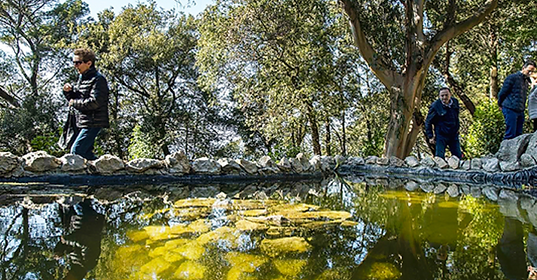
La Gloriette | A green jewel of a park on Capri | Villa Lysis
The Gloriette, the park that surrounds Villa Lysis and ends in a magnificent natural terrace overlooking the Marina Grande, is now open to everyone. 5,000 square meters of greenery brought back to life thanks to the great work of the volunteers from the “Capri è anche mia” association. So, after years of neglect, you can once again walk along those avenues, stop on a bench to read a book or swing gently in a hammock, surrounded by the lush garden commissioned by Jacques Fersen, who entrusted the designs to the historic gardener of Capri, Mimì Ruggiero. A Neapolitan by birth, Ruggiero was transplanted to Capri, where he opened a plant nursery. He owed his success to the king of the cannon, Alfred F. Krupp, who entrusted him in 1901 with planting out what are now the Gardens of Augustus. News of Ruggiero’s skills quickly spread among the illustrious guests on the island. The eccentric American Wolcott-Perry sisters wanted his brilliant touch in their garden at Villa Torricella, as did Queen Victoria of Sweden for Casa Caprile and the enigmatic Count Fersen for his park at Villa Lysis.
As Roger Peyrefitte wrote in his book Exile of Capri: “In addition to the orchids, for which he built a greenhouse next to the Villa, he planted narcissus, camellias, roses, hydrangeas, hibiscus, and azaleas. Contrary to his gardener Ruggiero’s advice, he refused to plant bougainvillea which he considered to be vulgar. He added myrtle to the bay bushes, in honor of Venus. He sought out all the varieties of the shrub that were growing on the island, the most strongly scented of which was named after Tiberius.” A lot of time has passed since then, and there are no longer any orchids, but many of the plants in that historic garden are still flourishing in this little jewel of nature.
Photo: © Raffaele Lello Mastroianni
CapriReview
Volunteers:
https://www.facebook.com/pg/caprieanchemia/photos/?ref=page_interna